
Heidelberg University Library
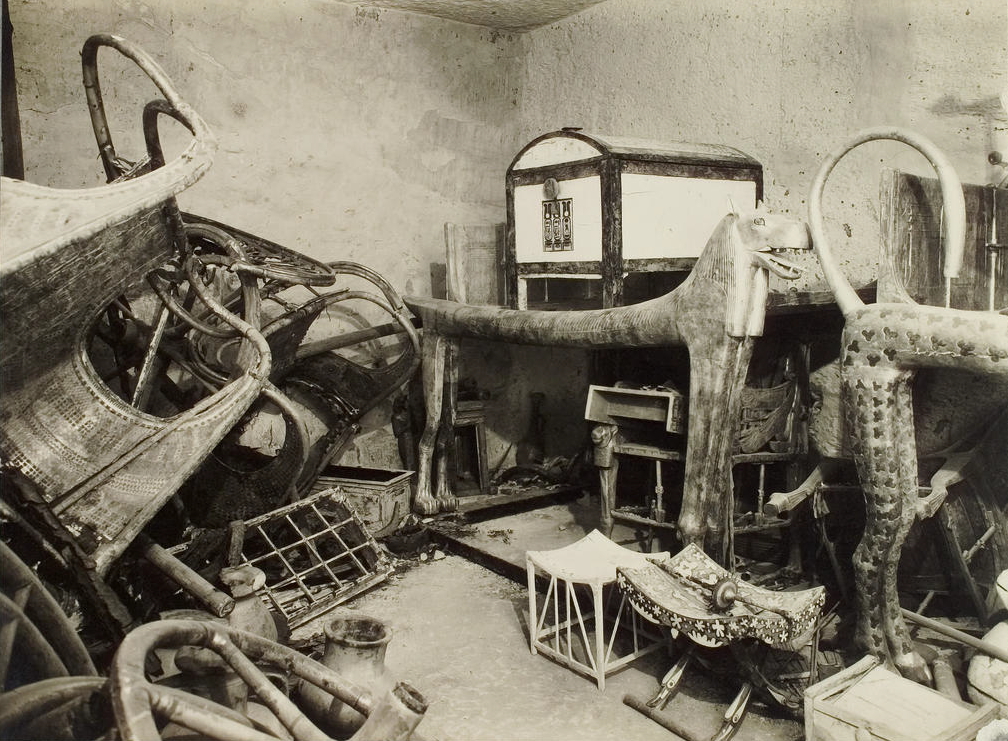
Few archaeologists can claim to have felt the surge of exhilaration that Howard Carter did on 27th November 1922, as he stood before the threshold of discovery in Egypt’s Valley of the Kings. The electric lights glared down on a scene of ancient splendour as Carter and his team gazed upon the antechamber of what they hoped to be Tutankhamun’s tomb. This first glimpse into a room untouched for thousands of years revealed objects of immense cultural and historical value, packed haphazardly—a prelude to the greater marvels that lay in wait. This was his journal entry on that momentous day.
The Diary Entry

© Griffith Institute, University of Oxford
27th November 1922
Callender prepared the electrical installation for lighting the tomb. This was ready by noon, when Lord C., Lady E., Callender and self entered and made a careful inspection of this first chamber (afterwards called the Ante-chamber).
In the course of the afternoon the local Inspector Ibrahim Effendi, of the Department of Antiquities at Luxor, came in the place of the Chief Inspector – he being absent on a visit to Kena.
It soon became obvious that we were but on the threshold of the discovery. The sight that met us was beyond anything one could conceive. The heterogeneous mass of material crowded into the chamber without particular order, so crowded that you were obliged to move with anxious caution, for time had wrought certain havoc with many of the objects, was very bewildering. Everywhere we found traces of disorder caused by some early intruder, objects over-turned, broken fragments lying upon the floor, all added to the confusion, and the unfamiliar plan of tomb repeatedly caused us to ask ourselves in our perplexity whether it was really a tomb or a Royal Cache? As the better light fell upon the objects we endeavoured to take them in. It was impossible. They were so many. Beneath one of the couches, the Thoueris couch in the S.W. corner, we perceived an aperture in the rock-wall which proved to be nothing less than another sealed-doorway broken open as by some predatory hand. With care Ld. C. and I crept under this strange gilded couch, and we peered into the opening. There we saw that it led into yet another chamber (afterwards called the Annexe) of smaller dimensions than the Ante-chamber and of a lower level. Even greater confusion prevailed here, the very stones that blocked the entrance, forced in when the breach was made, were lying helter-skelter upon the objects on the floor crushed by their weight. It was full of one mass of furniture. An utter confusion of beds, chairs, boxes, alabaster and faience vases, statuettes, cases of peculiar form, and every sort of thing overturned and searched for valuables. The remaining portions of the plaster covering the blocking of this doorway bore similar seal-impressions as on the other doorways.
In neither of these two chambers could we see any traces of a mummy or mummies – the one pious reason for making a cache. With such evidence, as well as the sealed doorway between the two guardian statues of the King, the mystery gradually dawned upon us. We were but in the anterior portion of a tomb. Behind that closed doorway was the tomb-chamber, and that Tut.ankh.Amen probably lay there in all his magnificent panoply of death – we had found that monarch’s burial place intact save certain metal-robbing, and not his cache.
We then examined the plaster and seal-impressions upon the closed doorway. They were of many types of seals, all bearing the insignia of the King. We also discovered that in the bottom part of the blocking a small breach had once been made, large enough to allow of a small man to pass through, but it had been carefully reclosed, plastered and sealed. Evidently the tomb beyond had been entered – by thieves! Who knows? But sufficient evidence to tell that someone had made ingress.
The results of our investigations were, (1) it was clear the place was Pharaoh’s tomb and not a mere cache; (2) that we had only entered the anterior chambers of the tomb, filled with magnificent equipment equal only to the wealth and splendour of the New Empire; (3) that we had found a royal burial little disturbed save hurried plundering at the hands of ancient tomb robbers.
It was a sight surpassing all precedent, and one we never dreamed of seeing. We were astonished by the beauty and refinement of the art displayed by the objects surpassing all we could have imagined – the impression was overwhelming.
Further Reading
Howard Carter’s diaries and journals can be read at the website of the Griffith Institute, University of Oxford. The entry above is reprinted by kind permission.
Also…
Leave a Reply