
Wikimedia

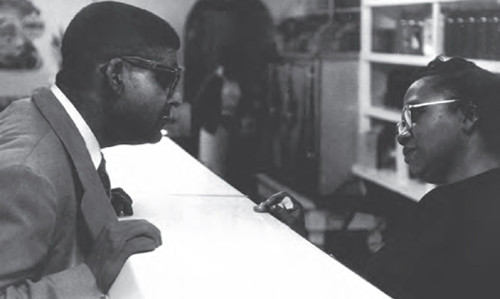
In November 1959, at a time of profound racial tension and segregation in the American South, journalist John Howard Griffin embarked on a remarkable and controversial journey. In an attempt to better understand the Black American experience, Griffin underwent a medical treatment to temporarily darken his skin and for six weeks placed himself in the shoes of those who suffered under the oppressive weight of Jim Crow laws—a bold act which, though it could not fully replicate the systemic racism and generational trauma faced by Black individuals, was an attempt to foster greater empathy and understanding among his predominantly white readership. Griffin chronicled his experiences in a diary that would later become a bestselling book. The following entry finds him almost three weeks into his odyssey, in Montgomery, Alabama.
The Diary Entry
November 25 [1959]
In Montgomery, the capital of Alabama, I encountered a new atmosphere. The Negro’s feeling of utter hopelessness is here replaced by a determined spirit of passive resistance. The Reverend Martin Luther King, Jr.’s influence, like an echo of Gandhi’s, prevails. Nonviolent and prayerful resistance to discrimination is the keynote. Here, the Negro has committed himself to a definite stand. He will go to jail, suffer any humiliation, but he will not back down. He will take the insults and abuses stoically so that his children will not have to take them in the future.
The white racist is bewildered and angered by such an attitude, because the dignity of the Negro’s course of action emphasizes the indignity of his own. It is a challenge to him to needle the Negro into acts of a baser nature, into open physical conflict. He will walk up and blow cigarette smoke in the Negro’s face, hoping the Negro will strike out at him. Then he could repress the Negro violently and claim it was only self-defense.
Where the Negro has lacked unity of purpose elsewhere, he has in Montgomery rallied to the leadership of King. Where he has been degraded elsewhere by unjust men of both races, here he is resisting degradation. I could not make out the white viewpoint in Montgomery. It was too fluid, too changeable. A superficial calm hung over the city. At night police were everywhere. I felt that the two races stood like blocks of concrete, immovable, and that the basic issues of right and wrong, of justice and injustice, were lost from view by the whites. The issues had degenerated to who would win. Fear and dread tensed both sides.
The Negroes with whom I associated feared two things. They feared that one of their own might commit an act of violence that would jeopardize their position by allowing the whites to say they were too dangerous to have their rights. They dreaded the awful tauntings of irresponsible white men, the jailing, the frames.
The white man’s fears have been widely broadcast.
To the Negro these fears of “intermingling” make no sense. All he can see is that the white man wants to hold him down to make him live up to his responsibilities as a taxpayer and soldier, while denying him the privileges of a citizen. At base, though the white brings forth many arguments to justify his viewpoint, one feels the reality is simply that he cannot bear to “lose” to the traditionally servant class.
The hate stare was everywhere practiced, especially by women of the older generation. On Sunday, I made the experiment of dressing well and walking past some of the white churches just as services were over. In each instance, as the women came through the church doors and saw me, the “spiritual bouquets” changed to hostility. The transformation was grotesque. In all of Montgomery only one woman refrained. She did not smile.
She merely looked at me and did not change her expression. My gratitude to her was so great it astonished me.
Further Reading
Griffin’s diary was published in 1961 by Houghton Mifflin with the title, Black Like Me. It’s an engrossing, enlightening piece of work.
Also…
Leave a Reply